Brushy Toothy
🪥Designing a Dual-Platform Learning Experience for Children’s Oral Health
Brushy Toothy is an interactive learning experience designed to help young children build consistent toothbrushing habits. The project explores how the same educational content can be adapted across two platforms—Articulate Rise 360 and Adobe XD—to better serve different users and learning environments.
Built in Adobe XD
Built in Articulate Rise 360
🎯 The Problem
Establishing healthy brushing habits early is critical, but for many children, brushing feels repetitive, rushed, or easy to skip altogether.
Caregivers often struggle with:
-
Keeping children engaged for the full two minutes
-
Encouraging consistency without resistance
-
Making brushing feel like something kids want to do
Research Informed Design
The design of Brushy Toothy is informed by established research on early childhood learning and behavior development. Young children benefit from observational learning and positive reinforcement, where modeled behaviors and reward systems support skill development and habit formation. These principles influenced the use of animated demonstrations, guided practice through the brushing timer, and a gamified reward system to encourage consistent engagement.
See more on research at the bottom.
The Brushy Toothy experience was designed for young children who are learning to brush their teeth independently while still receiving guidance from caregivers.
Users
Primary Users
Children ages 4–8 years old
At this stage of development, children are beginning to take ownership of daily routines but still benefit from visual guidance, repetition, and playful motivation.
Key learner characteristics include:
• Short attention spans
Young children may struggle to stay focused during the recommended two-minute brushing duration.
• Learning through play
Interactive experiences, characters, and rewards help maintain engagement.
• Visual learning preferences
Animated demonstrations and simple visual cues help children understand brushing techniques more effectively than verbal instruction alone.
• Developing independence
Children are beginning to complete hygiene tasks on their own but still benefit from guided support.
Because of these factors, learning experiences for this age group must be simple, visual, and rewarding in order to maintain engagement.

Secondary Users
Caregivers
While the primary users are children, caregivers also play an important role in the learning experience.
Parents and caregivers often:
-
introduce the app to the child
-
guide early brushing sessions
-
reinforce brushing routines
The design therefore supports shared interaction, allowing caregivers to help children start the brushing timer or watch the instructional video together.

💡 The Approach
Rather than designing a single solution, I created two distinct experiences using the same core content, each tailored to a different context:
-
A structured e-learning module for guided instruction
-
An interactive app prototype for self-directed engagement
This allowed me to explore how platform influences behavior, attention, and motivation.
By the end of the Brushy Toothy learning experience, children will be able to:
1. Brush for the Recommended Duration
Children will complete the full two-minute brushing cycle, using the app’s timer as a guide.
2. Demonstrate Proper Brushing Technique
After watching the instructional video, children will be able to identify and imitate proper brushing motions, including brushing the front, back, and chewing surfaces of their teeth.
3. Build a Daily Brushing Habit
Through repeated interaction with the brushing timer and reward system, children will begin to associate brushing with a consistent morning and bedtime routine.
4. Stay Engaged During the Brushing Process
Gamified elements such as star rewards, character unlocking, and progress tracking help children remain engaged throughout the brushing activity.



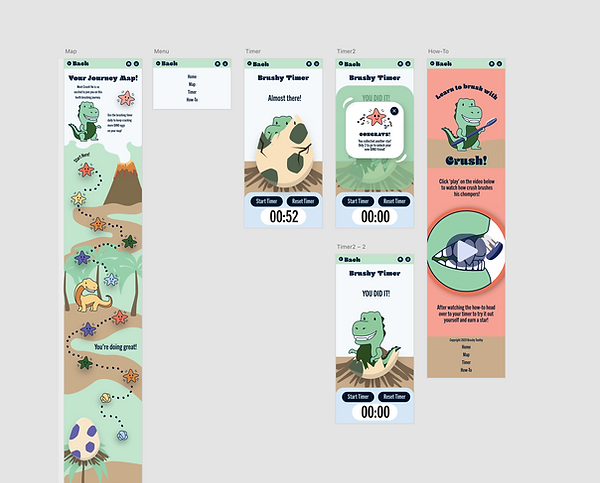
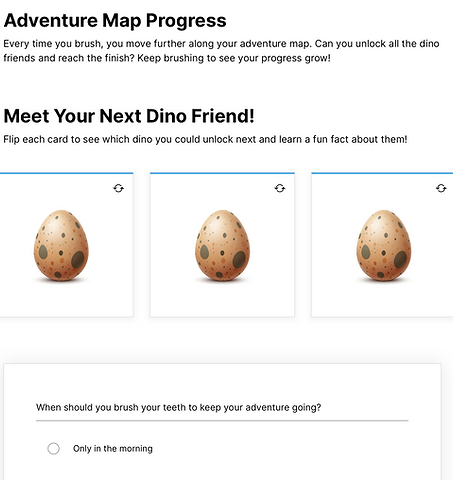
📱 Solution 1: Interactive App Prototype
Built in Adobe XD
Purpose: Encourage independent, habit-forming behavior through play
1
Tap-based interactions and exploratory navigation
2
Gamified elements to sustain attention
3
Visual cues and feedback to guide brushing duration
Experience: This version transforms brushing into a playful, self-directed activity—meeting kids where they are and making the routine feel rewarding instead of repetitive.

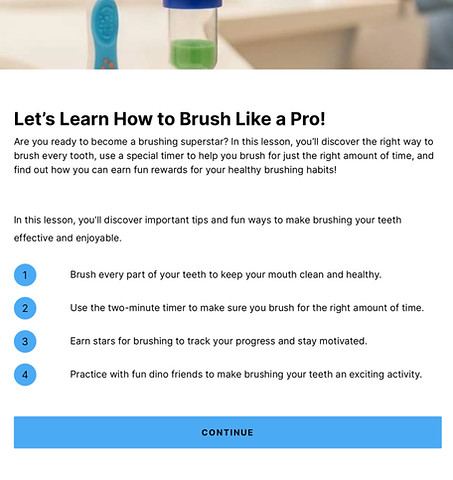
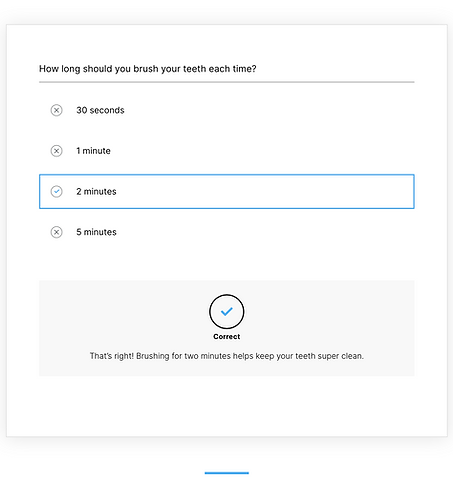
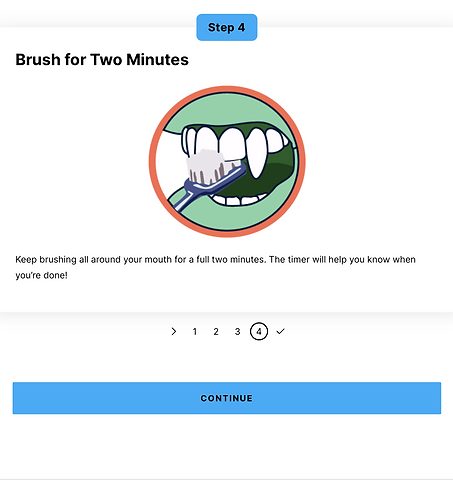
🖥️ Solution 2: Guided Learning Module
Built in Articulate Rise 360
Purpose: Support caregiver-led learning and step-by-step instruction
1
Linear progression with clear checkpoints
2
Simple, digestible content blocks
3
Reinforcement through repetition and visuals
Experience: This version acts as a teaching tool—ideal for introducing concepts, modeling behavior, and building foundational understanding in a structured way.
🔄 Key Design Decision
While the content remains consistent, the delivery changes intentionally:
-
Adobe XD → interactive, exploratory, child-driven
-
Rise 360 → structured, instructional, caregiver-supported
This approach emphasizes that effective learning design isn’t just about what you teach—but how and where users experience it.


Click through the gallery to learn more about the Instructional Design Rational and the UX Design Considerations for each screen.
The following screens demonstrate key moments within the Brushy Toothy learning experience.
Each interface was designed to support both the instructional objectives and usability needs of young learners.
Because the primary audience includes children ages 4–8, the interface prioritizes:
• simple navigation
• large touch targets
• minimal reading requirements
• visual guidance through characters and animation
Because Brushy Toothy focuses on building healthy brushing habits, learning success is measured through behavioral engagement rather than traditional quizzes or tests. The goal of the experience is not only to teach brushing technique, but to encourage children to consistently practice the behavior over time.
The following indicators can help measure whether the learning objectives are being met.
Brushing Session Completion
The brushing timer tracks whether children complete the full two-minute brushing cycle.
Completing the timer indicates that the learner has successfully practiced the recommended brushing duration.
Tracking timer completion helps determine:
• whether children remain engaged for the full brushing session
• whether the timer successfully reinforces the recommended brushing length
Star Rewards Earned
Each completed brushing session awards a star, which contributes to the child’s progression along the journey map.
The number of stars earned can provide insight into:
• how often children are brushing
• whether the reward system motivates repeated engagement
Consistent star collection suggests that children are repeating the brushing routine regularly.
Progression on the Journey Map
As children earn stars, they move along the adventure path and unlock dinosaur characters.
Tracking journey progression can help measure:
• long-term engagement with the learning experience
• sustained brushing habits over time
Because unlocking new characters requires multiple brushing sessions, the system encourages habit formation through repeated interaction.
Parent Observation and Reinforcement
Caregivers can also play an important role in evaluating learning outcomes.
Parents may observe whether their child:
• brushes for the full two-minute duration
• demonstrates proper brushing technique
• independently initiates the brushing routine
These observations provide valuable feedback about whether the learning experience supports real-world habit formation.
Brushy Toothy was designed to explore how instructional design principles, gamification, and visual storytelling can be combined to support habit formation in young learners. Through this project, I examined how everyday routines—such as brushing teeth—can become opportunities for learning when paired with engaging interaction design and clear instructional guidance.
One of the most important insights from this project was the value of simplicity when designing for children. Young learners benefit from interfaces that minimize cognitive load, rely heavily on visual cues, and guide users through clear sequential steps. By keeping the experience simple and predictable, the design allows children to focus on the behavior being practiced rather than navigating complex controls.
Another key takeaway was the role of gamification in reinforcing positive behaviors. Elements such as star rewards, egg hatching animations, and character progression were intentionally designed to create small moments of excitement that motivate children to continue brushing consistently over time.
The project also highlighted how instructional design and user experience design naturally complement one another. While instructional design focuses on defining learning goals and guiding behavior change, UX design ensures that the interface makes those learning moments intuitive and engaging.
Although this project began as a concept, it demonstrates how digital tools can support real-world habit formation in a playful and meaningful way. Future iterations of the experience could expand on this foundation by incorporating additional learning activities, caregiver dashboards, or personalized progress tracking.
Ultimately, Brushy Toothy reflects my interest in designing learning experiences that blend education, interaction, and storytelling to make everyday learning moments more engaging for young users.
References
Bandura, A. (1977). Social learning theory. Prentice Hall.
Skinner, B. F. (1953). Science and human behavior. Macmillan.
Centers for Disease Control and Prevention. (2023). Children’s oral health. https://www.cdc.gov/oralhealth/basics/childrens-oral-health/index.html